Showing posts with label animal behavior. Show all posts

Mar 2, 2016

The Controversy Surrounding Sociobiology: Genetic Determinism and Its Implications for Human Behavior and Social Justice

Individuals with genetic variations that increase their chances of survival and reproductive success will thrive at the expense of those with less advantageous genes, as dictated by natural selection. E.O. Wilson, an American biologist and entomologist, published Sociobiology: The New Synthesis in 1975, which aimed to explain animal and human behavior through evolutionary theory and natural selection. Wilson posited that species behave in ways that maximize the likelihood of transmitting their genes to future generations. Among many mammalian species, a mother's instinctive protective behavior aids in the survival and reproduction of her offspring.

The primary focus of sociobiology is on group behavior and instinctive behavior rather than individual behavior. Adaptive behaviors that are inherited in nonhuman animals are widely accepted among evolutionary biologists and remain a topic of active research. E.O. Wilson has posited that genetic influences play an equally if not more significant role in shaping human behavior than cultural factors. As a result, social and environmental factors are limited in their ability to alter human behavior. The application of sociobiology to human behavior has sparked significant controversy and criticism.

Stephen Jay Gould, a popular science writer and paleontologist, was at the forefront of criticism against biologic determinism. Gould and other evolutionary biologists have dismissed the notion that human behavior is predetermined solely by genetic makeup, although they acknowledge that genetics may play a role in behavior. The belief that genetics is an unchangeable factor that dictates an individual's fate can be used to justify social injustices, including racism, sexism, and the entrenchment of those in power. By challenging this belief, critics of biologic determinism hope to prevent the legitimization of authoritarian political policies and other forms of injustice.

According to sociobiology, the snow monkey's natural tendency to protect her offspring is a result of her desire to ensure their survival and reproductive success, thereby promoting the transmission of her genes.

Before the 1980s, sociobiology and behavioral ecology were largely interchangeable terms, with behavioral ecology examining the ecological and evolutionary underpinnings of animal behavior. In order to steer clear of the controversy that arises from attempting to apply theories of animal behavior evolution to human behavior, researchers in this field restrict their investigations to animals and generally refer to themselves as "behavioral ecologists."

Feb 27, 2016

Redefining Humanity: Jane Goodall and the Discovery of Tool-Making Chimps

For centuries, it was believed that the ability to make and use tools was unique to humans. This perception shaped the definition of “man, the toolmaker” as a distinct species. However, in 1960, a young researcher with no formal degree, Jane Goodall, shattered this belief with a groundbreaking discovery. While observing chimpanzees in the wild, she found that they not only used tools but also crafted them, challenging the long-held notion of human uniqueness.


Jane Goodall: From Passion to Scientific Breakthrough

  • Born in England in 1934, Jane Goodall had an early fascination with animals and Africa.
  • In 1958, she was hired by Louis Leakey, a famous paleontologist, as his secretary in Kenya.
  • Recognizing her keen observational skills, Leakey sent her to study chimpanzees in Gombe Stream, Tanganyika (now Tanzania).
  • Within just three months, Goodall made two startling discoveries:
    1. Chimpanzees were not strict herbivores—they ate small insects and even hunted other animals.
    2. Chimps used and created tools, a behavior previously thought to be exclusive to humans.

The Revolutionary Tool-Use Discovery

  • Goodall observed a chimpanzee using blades of grass to fish termites out of a mound, a clear act of tool use.
  • She later saw chimps strip leaves from twigs, fashioning simple tools to catch insects.
  • Other chimps were seen using sticks to scrape food, much like humans use spoons.
  • Some even created leaf sponges to collect water from tree hollows.
  • In different parts of Africa, chimps were documented cracking nuts with rocks, another clear sign of cognitive problem-solving.

Rewriting the Definition of “Man”

  • Goodall’s discoveries challenged the very foundation of what it means to be human.
  • Louis Leakey famously remarked, “We must now redefine ‘man’, redefine ‘tool’, or accept chimpanzees as humans.”
  • Her work demonstrated that intelligence, culture, and innovation were not exclusive to humans, but rather shared with other species.

The Legacy of Goodall’s Work

Jane Goodall’s research revolutionized primatology and anthropology, paving the way for new perspectives on animal intelligence and behavior. Her findings continue to influence studies on cognition, evolution, and conservation, forever changing the way we perceive the animal kingdom.


Before Jane Goodall’s observation that chimps use tools for food and water acquisition, it was generally believed that humans were the only species that made and used tools. Depending upon how one defines a tool, its use has also been reported in other mammals, birds, fish, cephalopods, and insects.


Feb 20, 2016

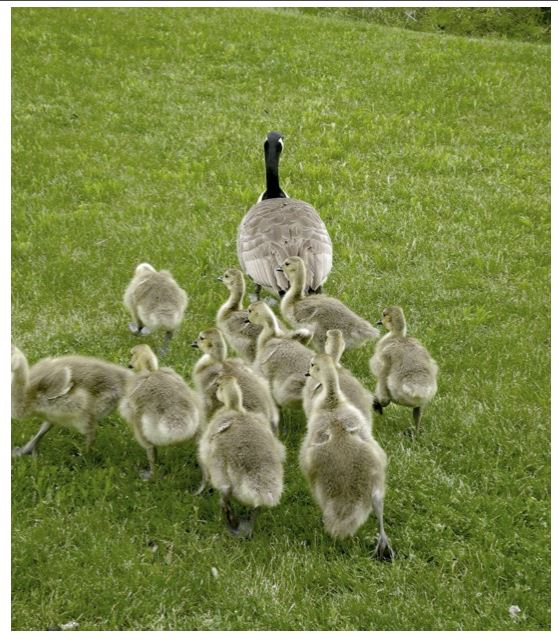
Imprinting in Birds: How Baby Geese and Ducks Choose Their Caregiver for Life

One of the most fascinating behaviors in the animal kingdom happens within hours of birth. If you’ve ever watched a baby goose or duck follow its mother closely just after hatching, you’ve witnessed a remarkable phenomenon known as imprinting. But what makes these tiny hatchlings latch on to their caregiver so quickly—and how do they even know who to follow?

The answer may surprise you: they don’t inherently recognize their mother. Instead, they form an emotional and behavioral bond with the first appropriate individual they see, a process that unfolds during a brief and critical window early in life.


What Is Imprinting?

Imprinting is a built-in biological mechanism in certain animals, especially birds, that allows newborns to form a strong attachment to a caregiver. This process happens only once and is irreversible. It's not based on memory or learning through reward, but on an innate drive to bond for survival.

The window for this bonding—called the critical period—typically lasts only a few hours after birth. During this time, the hatchling will imprint on the first moving object that seems like a caregiver, usually its mother. But if a human or even another animal is present instead, the newborn may attach to them just as strongly.


The Science Behind the Discovery

Although Douglas Spaulding, an English biologist, first observed this behavior in 1873, it wasn’t until decades later that imprinting was formally studied and understood. German zoologist Oskar Heinroth rediscovered it and passed his insights to his student, Konrad Lorenz, an Austrian scientist widely considered the father of modern ethology (the study of animal behavior).

In the 1930s, Lorenz conducted now-famous experiments where he hatched greylag goose eggs and made sure the goslings saw him first. The result? The goslings treated Lorenz as their mother, following him loyally—even ignoring actual geese in favor of him. This work earned Lorenz a Nobel Prize in 1973 and changed how scientists understand animal development.


How Long Does the Imprinting Period Last?

The timing of imprinting varies slightly across species:

  • Greylag Geese: Critical period lasts about 13 to 16 hours.
  • Mallard Ducklings & Domestic Chicks: Critical period closes by 30 hours post-hatching.

Once imprinting occurs, it cannot be undone. The bond remains for life, influencing both social and mating behaviors.


Why Imprinting Matters in Nature

Imprinting is more than just following a parent—it plays several key roles in survival and reproduction:

For Offspring:

  • Ensures safety by keeping hatchlings close to a protector.
  • Establishes social learning, guiding behavior and future interaction.

For Parents:

  • Directs care to their own biological young, avoiding wasted effort on unrelated offspring.

For Future Reproduction:

  • Shapes mate selection, encouraging animals to seek out similar species and avoid inbreeding or hybridization.

Unlike learned behaviors that rely on repetition or reward, imprinting is automatic and instinctive, emphasizing its importance in the early stages of life.


Key Insights to Remember

  • Imprinting is fast and permanent, happening within hours of birth.
  • It ensures survival, helping hatchlings recognize and follow a caregiver for protection.
  • Konrad Lorenz’s research revolutionized our understanding of how animals form early-life bonds.
  • Species-specific timing means imprinting must happen within a narrow window or not at all.
  • It influences not only behavior, but also mate selection, playing a role in long-term genetic survival.

Imprinting highlights just how deeply instinct and environment work together to shape behavior—and how critical the first few hours of life can be in setting the path for the future.

Several studies conducted with young birds have demonstrated that the imprinting response is instinctive, revealing that these birds lack inherent recognition of their biological mother.