Showing posts with label Anatomy. Show all posts

Sep 20, 2020

Anatomical Divisions of the Human Body

The human body is anatomically categorized into two primary regions, which serve as reference points for structural and functional analysis.

1. Axial Body Region

The axial region consists of structures that align with the central axis of the body, providing support and protection to vital organs. It includes the following:

  • Head (Cephalic Region): Encompasses the skull and facial structures, housing the brain and sensory organs.
  • Neck (Cervical Region): Connects the head to the torso and contains structures essential for circulation, respiration, and nerve transmission.
  • Thorax (Chest Region): Encloses vital organs such as the heart and lungs within the ribcage.
  • Abdomen: Contains the digestive organs, including the stomach, intestines, liver, and kidneys.
  • Pelvis: Provides structural support and houses the reproductive organs, urinary bladder, and portions of the intestines.

2. Appendicular Body Region

The appendicular region includes structures extending from the axial body, primarily responsible for movement and interaction with the environment. It consists of:

  • Upper Extremities (Upper Limbs): Includes the shoulders, arms, forearms, wrists, and hands, facilitating dexterity and fine motor skills.
  • Lower Extremities (Lower Limbs): Includes the hips, thighs, legs, ankles, and feet, playing a crucial role in mobility and weight-bearing functions.

Abdominal Subdivisions

To aid in medical and anatomical reference, the abdominal region is systematically divided into smaller sections for precise localization of structures and pathologies.

  • Nine-Region Method: This detailed classification divides the abdomen into nine regions, allowing for accurate anatomical and clinical assessment:
    1. Right Hypochondriac Region – Contains the liver and gallbladder.
    2. Epigastric Region – Houses the stomach and pancreas.
    3. Left Hypochondriac Region – Includes the spleen and portions of the stomach.
    4. Right Lumbar Region – Contains parts of the intestines and kidneys.
    5. Umbilical Region – Encompasses the small intestine and transverse colon.
    6. Left Lumbar Region – Houses parts of the intestines and kidneys.
    7. Right Iliac (Inguinal) Region – Contains the cecum and appendix.
    8. Hypogastric (Pubic) Region – Includes the bladder and reproductive organs.
    9. Left Iliac (Inguinal) Region – Houses parts of the sigmoid colon.
  • Four-Quadrant Method: A simpler approach commonly used in clinical practice divides the abdomen into four quadrants:
    • Right Upper Quadrant (RUQ) – Includes the liver, gallbladder, and part of the stomach.
    • Left Upper Quadrant (LUQ) – Contains the stomach, spleen, and pancreas.
    • Right Lower Quadrant (RLQ) – Houses the appendix and parts of the intestines.
    • Left Lower Quadrant (LLQ) – Includes parts of the intestines and reproductive organs.

These anatomical classifications provide a systematic framework for medical diagnosis, surgical procedures, and anatomical studies.


Abdominal Subdivisions


Sep 15, 2020

What are Anatomy and Physiology?

Anatomy

The term "anatomy" is derived from the Greek word "Anatome," meaning "to cut up." It refers to the study of the structures that make up the human body and the relationships between these structures. Anatomy encompasses several sub-specialties, including Gross Anatomy, Microscopic Anatomy, Developmental Anatomy, and Embryology.

  • Gross Anatomy examines the body's structure without the use of a microscope. It is further categorized into:
    • Systemic Anatomy: Studies the functional relationships of organs within a system.
    • Regional Anatomy: Focuses on specific regions of the body, studying the interrelations of structures within those areas.

Both systemic and regional approaches are used to study gross anatomy.

  • Microscopic Anatomy (Histology) requires the use of a microscope to study tissues that form the various organs of the body.

Physiology

The word "physiology" is derived from the Greek term for the study of nature. It focuses on understanding how the body and its parts function. Anatomy and physiology are often studied together to provide a comprehensive understanding of the human body.

Homeostasis

Homeostasis refers to the body's ability to maintain a stable internal environment, despite constant changes in the external environment. This relative stability of internal conditions is crucial for health and is achieved through the coordination of structure and function.

Under normal conditions, homeostasis is maintained by adaptive mechanisms, including control centers in the brain and chemical substances like hormones, which are secreted by various organs into the bloodstream. Key functions regulated by homeostatic mechanisms include blood pressure, body temperature, breathing, and heart rate.

Nov 29, 2014

Muscles and Bones: Working Together for Locomotion

Muscles are attached to bones through connective tissue called ligament, and when they contract, they move the bones, producing locomotion. The movement of bones is achieved through the action of two different bones that are attached by muscles. The point of attachment to bones has two ends, namely origin and insertion, where origin is the stationary end while the insertion moves. The thick part of the muscle between the origin and insertion that contracts is called the belly. Muscles are arranged in pairs, called antagonistic pairs, and each muscle has its own origin and insertion.

Flexor and Extensor Muscles: Antagonistic Pair

Flexor and extensor muscles work in pairs to move bones in two different directions. When the flexor muscle contracts, it bends the bone at the joint, while the extensor muscle straightens the bone at the joint. In the human body, most of the 650 muscles occur in such pairs, and the arrangement of these muscles is called the antagonistic arrangement.

Joints in Action: The Elbow Joint

The elbow joint is a synovial joint between the humerus, radius, and the muscles responsible for its movement are the biceps and triceps. The biceps is also called biceps brachii, and it arises by two heads: the long head from the glenoid cavity and the short head from the coracoid process of the scapula. Brachialis lies below the biceps brachii and arises from the anterior surface of the lower three-fifths of the humerus, inserting into the coronoid process of the ulna. Brachioradialis arises from the lateral side of the lower end of the humerus and extends most of the forearm, inserting into the lateral border of the distal shaft of the radius. Radius is lifted by the contraction of biceps brachii and brachioradialis, while ulna is lifted by the contraction of brachialis.

Triceps brachii is a muscle that causes extension, and it has three heads: long head, lateral head, and medial head. The long head arises from the scapula below the shoulder joint, the lateral head from the lateral surface of the humerus, and the medial head from the medial and lateral surface of the humerus. All three heads fuse at their lower end and insert through a common tendon on the olecranon process of the ulna. When the triceps brachii contracts, it exerts a powerful force on the upper end of the ulna, causing the extension of the forearm.

Muscles in Action 

Nov 26, 2014

Understanding Joints: Types and Structures of the Human Skeleton's Connecting Components

A joint, also known as an articulation, is a point where bones and cartilage come together. These joints are important for holding the skeleton together and allowing for movement.

Synovial joints

Joints are classified based on their movement and structure. There are three types of bones based on the amount of movement they allow, including immovable, slightly movable, and freely movable joints. In immovable and slightly movable joints, there is no space between the bones.

On the basis of structure, joints are classified into three types: fibrous joints, cartilaginous joints, and synovial joints.

Fibrous joints are immovable and held together by short fibers embedded in dense connective tissue. Examples include sutures in the skull and the articulation of teeth with the mandible and maxilla.

Cartilaginous joints are slightly movable and are connected by hyaline or fibrocartilage, such as the costal cartilages that connect the ribs to the sternum or intervertebral discs.

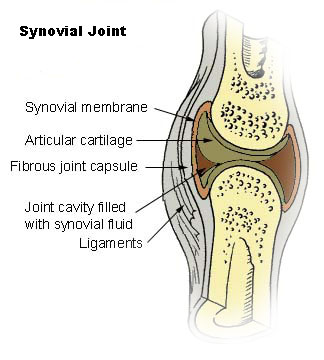
Synovial joints are freely movable and contain synovial fluid. These joints have a cavity separating the bones, which is lined by a synovial membrane that produces synovial fluid. Ligaments hold the bones in place, and menisci and bursae help reduce friction. Examples of synovial joints include the knee and shoulder joints.

There are six types of synovial joints: hinge, ball and socket, gliding, ellipsoid, pivot, and saddle joints. Hinge joints, like the elbow and knee joints, allow movement in one plane or direction only. Ball and socket joints, like the hip and shoulder joints, allow movement in various directions. Gliding joints only allow a sliding movement, while ellipsoid joints are modified ball and socket joints that allow movement in two directions. Pivot joints, like the articulation between the axis and atlas, allow rotation around a single axis. Finally, saddle joints allow movement in two directions and consist of two saddle-shaped articulating surfaces, like the carpometacarpal joint of the thumb.

Nov 21, 2014

Human Skeleton

The human skeleton is divided into two parts, the axial skeleton, and the appendicular skeleton. The axial skeleton consists of the skull, chest cage, vertebral column, and hyoid bone, whereas the appendicular skeleton comprises the pectoral girdle, pelvic girdle, forelimbs, and hindlimbs.


Human skull (side view)

Axial Skeleton

The axial skeleton includes the skull, chest cage, vertebral column, and hyoid bone.

Skull

The skull or cranium is a box cavity that protects the brain. The cranium consists of eight bones, out of which four are unpaired and two are paired. The bones of the face are 14 in number, out of which six are paired and two are unpaired. The skull bones are mostly flat and immovable, and they come together at joints called sutures.

Chest Cage

The chest cage consists of twelve pairs of ribs. Ten ribs are connected interiorly with the sternum, and the other two are floating. The rib cage provides support for a semi-vacuum chamber called the chest cavity.

Vertebral Column

The vertebral column supports the weight of the body and provides axial support to the head. It consists of 33 vertebrae named according to their location in the vertebral column. The vertebral column has four curvatures that provide more resiliency and strength in an upright posture than a straight column could.


Inferior nasal concha

An inferior view of the skull 


Interior view of Hyoid Bone 

Hyoid Bone

The hyoid bone is a small bone that lies at the tongue. It gives attachment to the tongue and serves as the site for the attachment of muscles associated with swallowing. It does not articulate with any other bone of the head.

Appendicular Skeleton

The appendicular skeleton comprises the pectoral girdle, pelvic girdle, forelimbs, and hindlimbs.

Vertebral Column

Pectoral Girdle

The pectoral girdle consists of a pair of clavicles and a pair of scapulas. The clavicles are a pair of collar bones that form the front of the pectoral girdle, and the scapulas are two shoulder blades that form the back part of the pectoral girdle.

Forelimb

The forelimb consists of the humerus, radius and ulna (forearm bones), carpals (eight short bones forming the wrist), metacarpals (five short bones forming the palm), and phalanges (three bones forming the fingers, two bones forming the thumb).

Chest Cage

Hindlimb

The hindlimb consists of the femur (thigh bone), patella (kneecap), tibia and fibula (leg bones), tarsals (seven short bones forming the ankle), metatarsals (five short bones forming the foot), and phalanges (fourteen bones forming the toes).

Pelvic Girdle

The pelvic girdle is a bony ring that protects the organs in the lower abdomen. It consists of two hip bones, which are large and heavy, and they articulate with the sacrum at the back.

Pectoral Girdle

The pelvic girdle is formed by a pair of hip bones, each of which is made up of three bones: ilium, ischium, and pubis. The two hip bones are joined anteriorly by a cartilage called pubic symphysis. The pelvic girdle protects and supports the reproductive and urinary organs, as well as the lower part of the digestive tract. It also provides a stable foundation for the attachment of the lower limb bones.

Hindlimb

The hindlimb, also known as the lower limb, consists of the following bones:

Femur: The femur, or thigh bone, is the longest and strongest bone in the human body. It articulates with the hip bone proximally and the tibia and patella distally.

Patella: The patella, or kneecap, is a small, triangular bone located in front of the knee joint. It protects the knee joint and helps to increase the leverage of the quadriceps muscle.

Tibia: The tibia, or shinbone, is the larger of the two bones in the lower leg. It articulates with the femur proximally and the ankle bones distally.


Forelimb

Fibula: The fibula is the smaller of the two bones in the lower leg. It is located on the lateral side of the tibia and provides attachments for muscles of the leg and foot.

Tarsals: The tarsals are seven bones that form the ankle joint.

Metatarsals: The metatarsals are five long bones that form the sole of the foot.

Phalanges: The phalanges are the bones that form the toes. There are 14 phalanges in each foot: three in each of the first four toes and two in the big toe.

Functions of the Skeletal System

The skeletal system performs several important functions in the human body, including:

Support: The skeletal system provides structural support for the body and helps to maintain its shape.

Protection: The bones of the skull, rib cage, and pelvis protect vital organs such as the brain, heart, lungs, and reproductive organs.

Movement: The skeletal system provides a framework for muscles to attach to, allowing for movement of the body.

Blood cell production: The bone marrow in certain bones produces red blood cells, white blood cells, and platelets.

Mineral storage: Bones serve as a storage site for important minerals such as calcium and phosphorus, which are necessary for many metabolic processes in the body.

The skeletal system is composed of the axial and appendicular skeleton, which together provide support, protection, and movement to the body. The individual bones of the skeletal system work together to form a strong, flexible, and dynamic structure that allows us to stand, move, and perform a wide range of activities.


Humerus


Pelvic Girdle


Hindlimb
  

Oct 1, 2009

Understanding the Spinal Cord: Your Body's Information Highway

The spinal cord stands as one of the most essential components of the human nervous system. This slender, cylindrical structure of nerve tissue stretches from the brainstem down to the lower back, serving as a vital communication highway between the brain and the rest of the body.

Spinal Cord 
Structural Anatomy of the Spinal Cord

Protective Framework: Vertebrae and Meninges

Encasing the spinal cord is the vertebral column—a series of intricately connected bones known as vertebrae. These vertebrae not only provide structural support but also form a robust shield against physical damage. Further safeguarding the spinal cord are three layers of specialized membranes called the meninges. These layers—dura mater, arachnoid mater, and pia mater—act as cushions, offering additional protection to the delicate neural tissue within.

Segmentation and Spinal Nerves

The spinal cord is meticulously organized into segments, each corresponding to a specific pair of spinal nerves. Altogether, there are 31 pairs of spinal nerves, each emerging from the spinal cord to serve distinct areas of the body. These nerves are named according to the region of the spine from which they originate, creating an orderly map of nerve distribution.

The spinal cord is divided into four primary regions:

  • Cervical Region: Controls signals to the neck, shoulders, arms, and hands.
  • Thoracic Region: Relays information to the chest and abdominal muscles.
  • Lumbar Region: Manages signals to the hips, thighs, and lower legs.
  • Sacral Region: Governs the pelvic organs and lower limbs.

Each region varies in the number of nerve segments it contains, reflecting the complexity of control needed for different parts of the body.

Functional Role of the Spinal Cord

Signal Transmission: Sensory and Motor Pathways

At the heart of spinal cord function is its role in relaying messages between the brain and the body. It houses two primary types of neurons:

  • Sensory Neurons: These transmit information such as touch, pain, temperature, and proprioception (body position) from the body to the brain.
  • Motor Neurons: These carry signals from the brain to muscles and glands, enabling voluntary movements and regulating essential bodily functions.

This bidirectional communication allows the body to respond swiftly and effectively to internal and external stimuli.

Reflex Arcs: Rapid, Involuntary Responses

Beyond simple transmission, the spinal cord also orchestrates complex reflexive actions without the need for direct brain involvement. Within its circuitry, networks of interneurons integrate sensory input and generate immediate motor responses. Reflexes such as withdrawing a hand from a hot surface or the well-known knee-jerk reaction are vital for survival, providing rapid, automatic protection against potential harm.

The Critical Importance of the Spinal Cord

The spinal cord’s intricate design and multifaceted functions underscore its critical role within the central nervous system. It not only enables us to perceive our environment and coordinate movement but also maintains fundamental autonomic functions essential for life.

Damage or disease affecting the spinal cord can lead to profound impairments, highlighting the need for ongoing research and clinical care in neurology and spinal medicine.


Final Note:
The spinal cord is far more than a simple communication channel; it is a dynamic, highly organized structure fundamental to human sensation, movement, and reflexive behavior. Understanding its structure and function illuminates just how integral it is to our ability to interact with and adapt to the world around us.