The eye is one of the body's most complex organs. When its parts fail to bend light onto the retina, vision gets blurred.
This guide covers the most common reasons people see an eye doctor. Each condition is shown with a credited diagram from Wikimedia Commons.
Refractive Errors: Myopia and Hyperopia
In myopia the eye focuses the image of a distant object in front of the retina rather than on it. Distant objects appear blurry. It is often caused by the eyeball being too long.
 |
| Diagram of the eye showing myopia: the focal point falls in front of the retina. Image: National Eye Institute, Public domain, via Wikimedia |
Hyperopia (farsightedness) works the opposite way: the eye focuses the image of a distant object behind the retina. Close-up objects appear even more blurry than distant ones. It can result from the eyeball being too short.
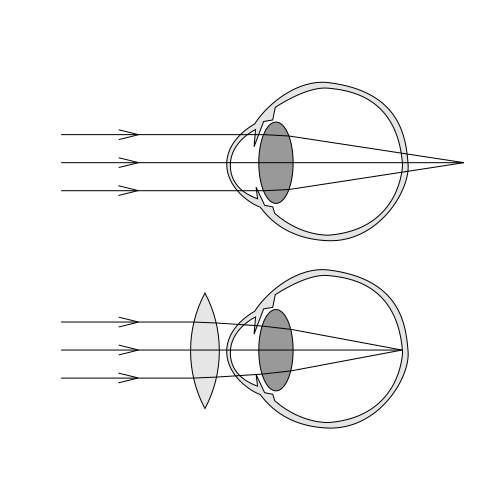 |
| Diagram of the eye showing hyperopia: the focal point falls behind the retina. Image: National Institute of Health, Public domain, via Wikimedia |
Astigmatism results from an cornea with unequal curvatures, distorting vision at all distances. Lines may appear wavy or stretched. It often accompanies myopia or hyperopia.
 |
| Diagram of the eye illustrating astigmatism from an irregularly shaped cornea. Image: BruceBlaus, CC BY-SA 4.0, via Wikimedia |
Age-Related Changes: Presbyopia and Cataracts
Presbyopia is the gradual loss of the eye's ability to focus on close objects, typically noticeable after age 40. The lens hardens and loses flexibility. It is a normal part of aging, not a disease. Reading glasses, bifocals or progressive lenses can fix it.
A cataract is a clouding of the eye's natural lens that grows slowly, often without pain. Symptoms include dim vision and more glare from lights. Colors may also look yellow or brown.
 |
| Photo showing presbyopia: age-related loss of the eye's ability to focus on close objects. Image: BruceBlaus, CC BY-SA 4.0, via Wikimedia |
 |
| Photo of a cataract: clouding of the eye's natural lens. Image: Rakesh Ahuja, MD, CC BY-SA 3.0, via Wikimedia |
Glaucoma and Early Detection
Glaucoma is a group of conditions that damage the optic nerve, often with high eye pressure. Early glaucoma has no symptoms. As it gets worse, side vision fades. Regular eye pressure checks can catch it early. Annual screenings are recommended for adults over 40 and those with a family history.
 |
| Photo of acute angle-closure glaucoma in the right eye. Image: James Heilman, MD, CC BY-SA 3.0, via Wikimedia |
Many eye defects develop slowly or without obvious symptoms at first. A comprehensive dilated eye exam can find problems while treatment works best. Adults should have exams every 1-2 years starting at age 40, or sooner if they have diabetes, a family history of eye disease, or other risk factors. Children should have vision screenings at well-child visits.
Key Terms in Plain English
These are the words in this article that would send you to a dictionary. Each one is given here the way it is actually used above.
| Term | What it means |
| Myopia | A refractive error where distant objects appear blurry because the image focuses in front of the retina. Often called nearsightedness. |
| Hyperopia | A refractive error where close objects appear blurry because the image focuses behind the retina. Often called farsightedness. |
| Astigmatism | A refractive error caused by an irregularly shaped cornea or lens, distorting vision at all distances. |
| Presbyopia | Age-related loss of the eye's focusing ability on close objects, typically beginning after age 40. |
| Cataract | A clouding of the eye's natural lens that dims vision and may eventually impair daily tasks; often treated with lens surgery. |
| Glaucoma | A group of diseases that damage the optic nerve, often related to increased eye pressure; can lead to permanent vision loss if untreated. |
| Refraction | The bending of light as it passes through the eye's cornea and lens to focus an image on the retina. |
| Retina | The light-sensitive layer at the back of the eye that converts light into electrical signals sent to the brain. |
| Optic nerve | The bundle of nerve fibers that carries visual information from the retina to the brain. |
| Dilated eye exam | An examination in which drops widen the pupil so the doctor can examine the retina and optic nerve thoroughly. |
Key terms used in this article, defined for quick reference.
Key Takeaways
- The six most common eye defects are myopia, hyperopia, astigmatism, presbyopia, cataracts and glaucoma.
- Myopia and hyperopia are refractive errors caused by the eye's shape. Astigmatism results from an uneven corneal curvature.
- Presbyopia is a normal age-related change, not a disease.
- Cataracts cloud the lens and are the leading treatable cause of vision loss.
- Glaucoma damages the optic nerve silently; early detection is sight-saving.
- Regular dilated eye exams are the best way to catch these conditions early, when treatment is most effective.
Frequently Asked Questions
Can eye defects be prevented?
Some, like myopia and hyperopia, are largely hereditary and cannot be prevented. Others, like cataracts and age-related vision changes, are associated with aging. Protecting eyes from excessive UV exposure and managing diabetes can reduce risk for some conditions.
How often should I have an eye exam?
Adults aged 18-60 with no risk factors should have an exam every two years. Adults over 61 and those with diabetes, high blood pressure, a family history of eye disease, or taking certain medications should be examined annually. Children should be screened at well-child visits.
Is astigmatism hereditary?
Yes, astigmatism can run in families. It can also result from eye injury, surgery, or disease. A prescription for cylindrical lenses can correct most cases.
Can cataracts be cured with drops or diet?
No. The only effective treatment for cataracts is surgery to replace the clouded lens. No drop, medication, or diet has been proven to reverse or prevent cataract formation.
Does reading in dim light damage the eyes?
No. It can cause eye fatigue temporarily, but does not cause permanent damage or worsen any underlying eye defect.
Key references
• Myopia — Wikipedia
• Hyperopia — Wikipedia
• Astigmatism — Wikipedia
• Presbyopia — Wikipedia
• Cataract — Wikipedia
• Glaucoma — Wikipedia
• Eye exam guidelines — American Academy of Ophthalmology
Sources: Wikipedia articles on myopia, hyperopia, astigmatism, presbyopia, cataract and glaucoma, together with the American Academy of Ophthalmology's eye exam guidelines. All were checked on 15 October 2026. Images are from Wikimedia Commons under the license named in each caption.

No comments:
Post a Comment