There is a claim in most explanations of this subject that excretory systems grew more complicated over time, and that mammals ended up with the most advanced version.
That claim is wrong, and it is wrong in a way that makes the subject harder to learn.
An earthworm is not an early draft of a mouse. Both descend from a common ancestor, and evolution branched. Neither branch is waiting to turn into the other.
So this post asks a different question. Not which animal has the best system, and not how far up the list it sits. It asks why an excretory organ comes into existence at all, and what forces a new one to appear when it does.
 |
| Hämbörger. Contractile vacuoles in Paramecium. This is the organ the earlier version of this post said was not needed, because it claimed waste simply diffused away. CC BY-SA 3.0, via Wikimedia Commons. |
There Is No Ladder
The earlier version of this post ran in a straight line. Diffusion, then flame cells, then metanephridia, then Malpighian tubules, then fish, then amphibians, then reptiles and birds, then mammals. It called mammals the evolutionary peak.
Three things are wrong with that, and only one of them is a matter of taste.
Evolution branches, it does not queue
Segmented worms, arthropods and vertebrates are separate lineages. None of them is descended from any of the others.
Each inherited an excretory organ from a different ancestor, and each solved the same problem with different plumbing. Putting them in a row makes an arrangement out of a tree.
Nothing is the peak
There is no top of the ladder, and there is no direction it is pointing. A mammal is not a more advanced earthworm. It is a mammal.
The earlier version also credits nature with an ability to optimize. Selection has no goal and no engineer. What persists is whatever left more descendants, and a great deal of what does not persist would have suited a purpose just as well.
Habitat is not the sorting variable
The post sorted animals by where they live, and that is the one variable that does not decide the matter. Sharks, rays and skates swim in seawater and retain urea on purpose, so their body fluids match the sea around them.
What the waste costs in water is a separate question, and it has its own article on this blog, linked at the end.
There is one sequence in the whole subject that is genuinely a sequence, and it comes later.
Why an Animal Needs an Organ at All
Diffusion is a real mechanism. Materials cross a membrane all the time, and for a small animal it is enough.
It is enough because of geometry. A flatworm is thin, so almost every cell sits close to the surface. Nitrogenous waste can simply cross outward, and the original post is right about that.
Now change the shape. Make the animal bigger, or rounder, and the cells in the middle are too far from any surface for diffusion to keep up. Waste accumulates in the core faster than it can leave.
That is the whole trigger. The problem is not that the animal is advanced or that it has moved onto land. The problem is that its middle is too far from its edge.
Once you pump, a second problem appears. You have drawn fluid across a membrane to get rid of the waste in it, but that fluid carries everything else too, at concentrations the body cannot afford to lose.
So the organ has to take most of it back. Which gives a sequence that every one of these organs runs, in this order.
| Step | What happens | What it is for |
| Filter | Body fluid is drawn in | Getting to the waste at all, and at speed |
| Reabsorb | Most of the filtrate is taken back | Keeping salts and useful solutes instead of losing them |
| Secrete | What the body wants rid of is added | Getting to the target compounds on their way out |
Three steps, and every excretory organ on the list does all three.
That is why the organs that look nothing alike still behave like relatives. A contractile vacuole, a flame cell, an earthworm nephridium, a Malpighian tubule and a human nephron are five plumbing arrangements for one algorithm.
Five Organs, One Design
| Animal | Organ | Where the fluid goes | What drives it |
| Paramecium | Contractile vacuole | Straight out of the cell | Filling and emptying on a cycle |
| Flatworm | Protonephridium | Pores on the body surface | Beating cilia in flame cells |
| Earthworm | Metanephridium | A pore in the next segment | A ciliated funnel, one per segment |
| Insect | Malpighian tubule | Into the gut | Ion secretion, with water following |
| Vertebrate | Nephron | To the bladder and outside | Blood pressure at the glomerulus |
Five animals, three steps, and a different answer to where the water goes.
The contractile vacuole: the organ the earlier version deleted
Start with the one the original left out, because it is the one that shows the argument best.
A Paramecium in fresh water is living in a medium that is hypotonic to its own cytoplasm. Water therefore enters the cell continuously, through the whole surface, and it does not stop.
Diffusion cannot solve this. Waste leaving slowly is not the issue. Water arriving too fast is.
The Paramecium has a contractile vacuole instead: a fluid-filled chamber that fills, swells, and then empties to the outside on a regular cycle. Work on the organelle shows it takes up not just excess water but ions as well. The emptying is driven by a proton gradient produced by a molecular pump.
So this is not a membrane that leaks more easily. It is a powered pump on a timer, and it is the first excretory organ on the list.
 |
| Deuterostome. A Paramecium, with the contractile vacuole labelled. Fresh water is hypotonic to the cell, so water enters continuously and has to be pumped back out. CC BY-SA 3.0, via Wikimedia Commons. |
Protonephridia: the flatworm version
A flatworm solves the same distance problem with flame cells, the ciliated terminals of a tubule network running through the body.
The beating cilia draw fluid into the network, and the fluid drains to pores on the body surface. Gravity is not doing the work here; the cilia are.
Some of these terminals are walled, and those units are called solenocytes. The wall makes them less leaky, which lets them build enough pressure to move fluid against a gradient.
The earlier version described this organ as the first specialized excretory system in evolution. Nothing supports that. No evidence makes protonephridia ancestral to any later excretory organ. They are a solution flatworms arrived at, and that is interesting enough without the crown.
 |
| Superdupersmartguy. The protonephridial system of a flatworm: a network of tubules ending in flame cells and draining to pores on the body surface. CC BY-SA 4.0, via Wikimedia Commons. |
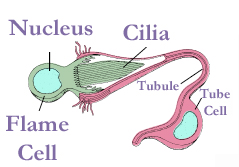 |
| Anilocra. A flame cell, the ciliated terminal unit that drives fluid through a flatworm protonephridium. The beating cilia do the work. Public domain, via Wikimedia Commons. |
 |
| Harmer, Sidney Frederic, 1862-; Shipley, A. E. (Arthur Everett), Sir, 1861-1927. Solenocytes, the walled variant of the flame cell. The wall makes the unit less leaky, which is what lets it build a higher pressure. CC0, via Wikimedia Commons. |
Metanephridia: one organ per segment
An earthworm runs its own excretory organ in every segment. A ciliated funnel draws fluid from the body cavity of one segment, a tubule carries it through the partition, and it leaves by a pore in the segment behind.
The win is not sophistication. It is that each segment can be handled on its own, instead of depending on one long slow flow from one end of the animal.
 |
| AlejandroLinaresGarcia. An earthworm. Segmentation is the point: each segment carries its own metanephridium, so fluids are handled locally. CC BY-SA 3.0, via Wikimedia Commons. |
Malpighian tubules: a different drain, doing more than draining
An insect solves the same problem and sends the fluid somewhere unusual: into the gut.
The earlier version said the tubules extract waste and convert it into uric acid. They do not convert anything. The tubule cells move ions into the tube, water follows them by osmosis, and the resulting fluid passes down into the gut. Nitrogen processing happens in other insect tissues.
This is worth pausing on, because it is the difference between an organ being simple and an animal being simple.
An insect body plan is more compact than a mammal's. Jobs that a mammal spreads across a liver, a kidney and an immune system get shared out among fewer tissues. The same tubule is also where insects handle insecticides such as DDT, and it can mount its own defense against bacteria.
So the Malpighian tubule is not an earlier, cruder version of a nephron. It is a nephron's job done by a different arrangement, with a different set of passengers.
 |
| USDAgov. A house fly. The insect Malpighian tubule is the model organ for modern work on fluid transport, mostly done in the closely related fruit fly. CC BY 2.0, via Wikimedia Commons. |
The vertebrate nephron
The vertebrate version runs the same three steps with a different pump.
Blood pressure at the glomerulus does the filtering. That pressure step is what everything else depends on, because it is what puts the filtrate under control in the first place.
The tubule then reabsorbs, and further along the loop of Henle rearranges what is left so it can be concentrated.
This is the organ most people picture when they hear the word kidney, and it is worth knowing what makes it different from the other four.
 |
| Tieum. Glomerular filtration. The pressure step is what makes the architecture possible: without it there is nothing to concentrate. CC BY-SA 4.0, via Wikimedia Commons. |
 |
| Holly Fischer. The cell types of a nephron. Every vertebrate has millions of these, and the number is fixed before birth. CC BY 3.0, via Wikimedia Commons. |
One Kidney, Three Stages
Now the sequence that is real, because it runs inside one lineage rather than across unrelated ones.
During vertebrate development the kidney is built, used, and replaced twice, in a fixed order.
| Stage | When it works | Scale |
| Pronephros | The working kidney of bony fish and amphibian larvae, and of larval hagfish and lamprey | A small number of units |
| Mesonephros | The adult kidney of most fish and amphibians | More units |
| Metanephros | The adult kidney of reptiles, birds and mammals | Many thousands of units |
Three stages in one lineage. The trend is surface, not sophistication.
Each stage is simply more filtering units than the one before. The pronephros is not a worse kidney than the metanephros. It is a smaller one, doing the same job at a scale that suited the animal at that stage.
The earlier version of this post had a section headed evolution of excretory systems in vertebrates and did not mention any of the three. That is the section the heading was promising.
 |
| Ashley Sawle. Nephrons forming during kidney development. This is where the whole budget is set, because no new nephrons are made afterwards. CC BY-SA 3.0, via Wikimedia Commons. |
You Get Your Nephrons Once
Here is where the architecture stops being a comparative question and becomes a personal one.
In mammals, kidney development has an ending, and it is a firm one. Nephrogenesis, the process that makes new nephrons, stops. It stops at a synchronized point across several regions of the developing kidney, and it is tied to the exhaustion of the progenitor cells that do the making.
After that point, no new nephrons are formed. Not slowly, not under demand, not in compensation for damage.
Which means a mammal's lifelong kidney function is settled by the complement of nephrons it built before birth.
Between one person and the next, the size of that endowment varies by as much as tenfold. That variation accounts for a real part of the difference in who goes on to develop kidney disease.
This is why being born early matters more than it looks. A premature baby is born partway through the window in which nephrons are still being made, so ends up with fewer of them. Fewer nephrons is a recognized risk factor for high blood pressure, chronic kidney disease and kidney failure later in life.
So the answer to why any of this architecture matters is not really that it is more advanced. It is that the structure is a budget, spent once before birth, and never refilled.
For what each waste costs in water, which is the other half of this subject and a different question, see the companion post on excretion.
Key Terms in Plain English
These are the words in this article that would send you to a dictionary. Each one is given here the way it is actually used above.
| Term | What it means |
| Diffusion | Movement of a substance across a membrane down a concentration gradient, with no energy spent. |
| Hypotonic | Lower concentration of dissolved particles than the cell inside. Water flows in through it. |
| Contractile vacuole | The organelle that pumps excess water out of a freshwater protozoan. |
| Flame cell | The ciliated terminal of a flatworm protonephridium. |
| Solenocyte | A walled flame cell that can build higher pressure. |
| Protonephridium | The flatworm excretory organ, made of tubules ending in flame cells or solenocytes. |
| Metanephridium | The earthworm organ, one per segment, draining through a funnel and out a pore. |
| Malpighian tubule | The insect organ draining into the gut rather than to a separate outlet. |
| Nephron | The vertebrate filtering unit, about a million per human kidney. |
| Glomerulus | The capillary tuft where blood pressure drives filtration. |
| Pronephros | The first kidney stage. The working kidney of fish and amphibian larvae. |
| Mesonephros | The second kidney stage. The adult kidney of most fish and amphibians. |
| Metanephros | The third kidney stage. The adult kidney of reptiles, birds and mammals. |
| Nephrogenesis | The making of new nephrons. It stops, and never restarts. |
Terms used above, in roughly the order they first appear.
Key Takeaways
- There is no ladder. Segmented worms, arthropods and vertebrates are separate branches, and none of them is an earlier version of another.
- An excretory organ appears when an animal gets too big, or too round, for waste to leave by diffusion. The driver is distance, not habitat.
- Every one of these organs runs the same three steps: filter, reabsorb, secrete.
- Diffusion cannot be the whole story in a freshwater protozoan, because fresh water is hypotonic and water arrives continuously. The contractile vacuole is a powered pump, and the earlier version of this post deleted it.
- The Malpighian tubule does not convert waste into uric acid. It secretes ions, water follows, and the fluid goes to the gut.
- The vertebrate kidney really does run pronephros, mesonephros, metanephros, and each stage is more units rather than a better design.
- Nephrons are made before birth and never replaced. Lifelong kidney function is settled by the endowment built in that window.
- How much the waste itself costs in water is a different question, covered in the companion post.
Frequently Asked Questions
So which excretory system is the most advanced?
That question has no answer, because it assumes a direction that does not exist.
Each organ fits the animal that has it and the problems that animal actually has.
Why is a flatworm so flat?
Its shape is its excretory system. A thin body puts nearly every cell close enough to the surface for diffusion to work.
A round worm of the same size would need an organ, because its middle would be too far from its edge.
Is a marine mammal's kidney worse than a human's?
No. It is built to a different spec, and in a marine mammal that spec is very long loops and very concentrated urine.
A person who never touched salt water has a kidney with no use for that much concentrating power.
Can an adult grow new nephrons?
No. In mammals nephrogenesis stops, and no new nephrons form afterwards.
That is why kidney damage is lasting in a way that damage to many other tissues is not.
Do invertebrates have the same three steps?
Yes. Filtering, reabsorbing and secreting shows up in a flame cell and in a human nephron alike.
The plumbing differs enormously. The order of operations does not.
Key references
• Protonephridium: flame cells and solenocytes in flatworms
• Metanephridium: nephrostome and nephridiopore
• Malpighian tubule: draining into the gut in insects
• Nephron and the glomerulus: filtration, reabsorption, secretion
• Contractile vacuole: how a freshwater protozoan pumps out water
• Vertebrate kidney: pronephros, mesonephros, metanephros
• For what the waste chemistry costs, see the companion post
• Plattner 2015, the contractile vacuole complex of protists, Crit Rev Microbiol 41(2):218-227 -- the organ the earlier version deleted
• Dow 2009, insights into the Malpighian tubule from functional genomics, J Exp Biol 212(3):435-445 -- why the tubule does not convert waste
• Perl, Schuh & Kopan 2022, nephron endowment, Nat Rev Nephrol 18(11):683-695 -- nephrons are made once and never replaced
Figures are from Wikimedia Commons, with the author and license named in each caption. Measurements are from the cited papers.

No comments:
Post a Comment